
The New Way To Sell On Webinars
Stop Pitching Like Rent Is Due Tomorrow, Start Being Abundant And Understanding Your Audience's Needs

The other day, I was sitting at my desk super unfocused.
You know when you have those days when you are just spinning around in your chair, pinging between Slack, WhatsApp and your email inbox?
Yeah, that was me.
And in my email inbox, I noticed an email.
An email from none other than Mr Charlie Morgan himself.
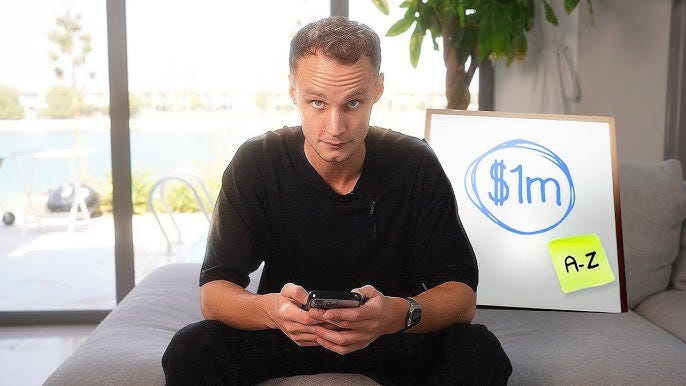
It’s great to see he is FINALLY utilising his email list that I have been subscribed to for like a year and received baso no emails from.
But back on topic.
I clicked on this email for a very specific reason.
That reason was that a few weeks ago…
I heard him say in one of his mastermind videos on YouTube that he recorded 7 DIFFERENT VSLs in ONE WEEK, that they are currently testing (see vid below)…
So, I clicked on the CTA in the email to have a gander at what he’s doing…
Because Morgan is someone actually worth studying, and I’m looking forward to seeing his pivot away from offer → pain-based marketing.
So, I watched the first minute or so of it…
Thought his hook was pretty cool…
And then I saw THIS (see 1:15 mins in)!
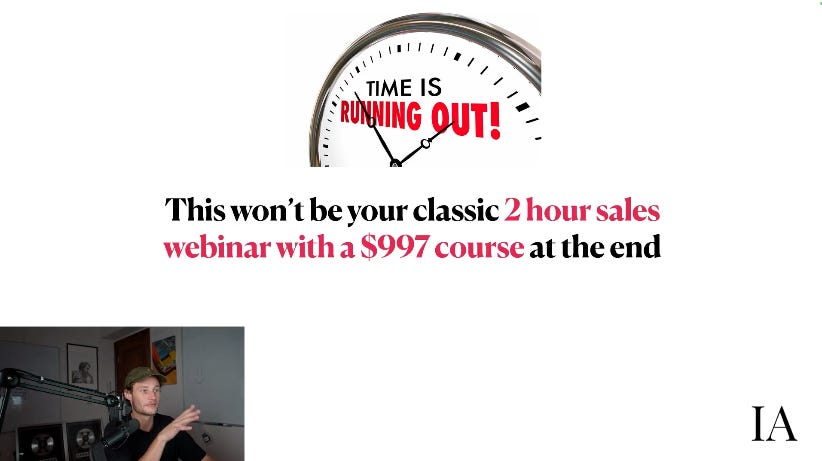
And I almost spat out my coffee.
“HOW DARE YOU COME AFTER MY BABY LIKE THAT?!” - I said to myself.
But when I calmed down and let old Morgan off the hook for his sly comment…
Something clicked for me, and it got me thinking…
This isn’t the first time, and probably won’t be the last time I have heard someone use this example of webinars being this ‘scammy’, ‘horrible’, ‘bait and switch’ sales mechanism.
It’s actually something that I see spoken about far too commonly in the info game, but part of me does understand it.
And I understand it because it comes from the super aggressive $997 pitch fests that were rinsed by ClickFunnels Classic users in 2016.
(Shoutout Tai Lopez)

And it’s funny because I didn’t realise how much of an impact this belief actually has on people when it comes to doing webinars, and the more I thought about it…
The more I realised that this actually puts offer owners OFF doing webinars, because every time they think about doing a webinar…
They get scared.
They get scared that they’re about to become that person.
They are about to become “He who must not be named”…
THE GURU!

With the countdown timer, the ‘10 spots left’ scarcity, the “BUT WAIT, THERE’S MORE” energy that makes you want to go to church afterwards.
We all know they exist.
We’ve seen them, we’ve sat through them.
The whole thing feels like a trap from the start.
The energy is weird.
And as a result…
This puts them off, and they end up not wanting to run webinars at all…
REGARDLESS of the fact that it would make them a f**k ton of money.
Or even worse…
They choose to do webinars, but they present with this weird apologetic-type energy, like they’re already sorry for what’s about to happen.
They rush through the content, so nobody really learns anything.
They downplay their offer, so fewer people convert.
They practically whisper the price because they don’t want to be ‘salesy’.
And then guess what…
You struck out twice on a double whammy.
Not only did you pull your punches…
You make fuck all money from it as well.
Not because webinars don’t work.
But because you’ve internalised this idea that selling on a webinar means you have to become someone you’re not.
Someone pushy.
Someone manipulative.
Someone who cares more about closing than actually helping.
And I have noticed this before in demo runs with clients, where I can feel their energy is slightly off - and often we just need to re-frame and remind them that everybody is going to leave this call better than they came…
Regardless of whether they choose to work with you at the end or not.
So because we like to do things different round ‘ere, we have constructed and tested a new way to write, present and sell on webinars.
One that doesn’t feel salesy at all.
One where the audience feels so deeply understood that when you finally present your offer, it doesn’t feel like a pitch, it feels like an act of love.
Where our webinars feel almost like a therapy session, instead of a sales call.
And the audience seems to be loving them, and the results have been 10/10.
Reference: 75 calls booked for a ‘micro-creator’ and 45 calls booked for another ‘micro-creator’ this week alone, targeting sceptical, older people.
That’s exactly what we’re going to unpack today.
And it all starts with a psychological principle that changed everything about how I write webinars:
Unconditional Positive Regard - By Carl Rogers
Now, funnily enough, I actually learned about this when studying A-Level Psychology when I was younger, but I didn’t remember the concept fully until I was crafting this newsletter and was researching this principle, and realised it already existed.
So let’s start from first principles here.
We do webinars to make money…
But in order to make money, you have to ‘sell’ something, because money doesn’t come from the sky.
And a lot of people have this negative connotation (even established business owners) about ‘selling’.
When you are selling 1-1 on a sales call, nobody sees the call recording.
You can hide behind a Gmeets and nobody notices…
I’m sure we have all heard stories of closers doing some pretty crazy sh*t to get someone to close on a call, and they can do that because like I said…
Nobody is going to see it.
But on a webinar, you are putting yourself out there, and it’s there to see for the public.
And the reason most webinars feel gross isn’t because they’re ‘selling’.
It’s because they’re selling from a place of judgment, and they attack the beliefs of the prospects TOO MUCH.
On a sales call, you can do this 1-1 because you can read the other person’s body langauge, and you get real time feedback loops.
But on a webinar, we don’t have that, we have to change our approach to avoid taking it a step too far.
For Example:
“You’re doing it wrong. You don’t have the right strategy. You don’t know what you’re doing. You’re stuck because you’re missing this one thing. And guess what? I have that thing. Pay me money mwahahaha”
Underneath all the value and the case studies and the “aha moments,” there’s this implicit message that runs through the prospect's mind:
You’re broken, and you aren’t good enough. You need my thing.
The hard thing is that this is kinda true, and we need them to arrive at the outcome of ‘You need my thing’ or else they won’t buy.
And the funniest thing to me about sales is that the audience (likely) would:
Be better off with your offer if they had it.
Your offer would help them if they had it.
Their life, and the life of people around them, would be better if they had it.
But they still don’t buy…
Why?
The entire presentation was designed to make them feel inadequate, so they’d buy the solution.
Whereas with this new approach we are running with right now…
We want them to feel READY to take action, not belittle them to the point they feel so small and shy that they leave feeling worse than when they came.
We WANT them to feel adequate already.
We WANT them to feel large, broad and confident in themselves enough that they are willing to bet on their future, and an investment in themselves.
We want them to feel like they DESERVE this, and they SHOULD do this out of a place of abundance, not from a place of lack or scarcity.
I got this idea after reading Nero Knowledge’s book, Outsmarting Reality.
When you use a technique like visualisation, and you are filled with the emotion that comes with making your goals a reality…
You feel ready to run through a brick wall.
You feel like Tobey Maguire dancing through the streets of NYC.
You feel like Bradley Cooper trading stocks on NZT.
So knowing this, would it not be beneficial for us to get them into their desired state so they take the action they would take them into their desired state?
Perhaps. It’s at least food for thought.
And when we compare that to what most people do on webinars by creating TOO MUCH pain and agitating TOO MUCH…
We are re-affirming that they are in fact struggling, and they are in fact in a bad situation and we are taking the wind out their sales and then expecting them to book a call or buy something.
Would it not be better for someone to be gassed and excited and want to book a call ASAP, rather than having someone book in a state of anger or frustration?
Now, I don’t want you to get this twisted and think we aren’t putting ANY pain in there at all. We are, but we aren’t spending 60 minutes grilling people and then swooping in with our offer like a fucking hero.
It works, in some cases.
It converts some people.
But it also makes everyone else feel like shit.
Including you, the person presenting it.
Because deep down, you know you’re not actually there to help.
You’re there to manufacture enough discomfort that people feel compelled to buy.
And that’s why you hate doing webinars in the first place.
You don’t want to be that person. You shouldn’t want to be that person.
But here’s where it gets interesting…
What if you could sell just as effectively…
In fact, even MORE effectively…
Without making anyone feel judged, broken, or inadequate?
What if you could present your offer as an invitation, not a rescue mission?
That’s where Carl Rogers comes in, so let me take you back to 1957.
Carl Rogers, a psychologist who basically revolutionised therapy, published a paper outlining the conditions necessary for therapeutic change.
One of those conditions was something he called unconditional positive regard.
Here’s what it means in plain English:
Unconditional positive regard is the practice of accepting and supporting another person without judgment or conditions.
It doesn’t mean you approve of everything they do.
It doesn’t mean you pretend they’re perfect.
It means you see them as fundamentally whole and worthy, regardless of their current situation or mistakes.
In therapy, this creates a safe space where people can explore their problems, accept themselves, and ultimately grow.
Because when someone feels truly accepted…
Not judged, not fixed, not saved…
They’re more likely to make real, lasting change.
Now, here’s the million-pound question that I asked:
What if we could bring this energy to a webinar?
What if, instead of spending 60 minutes pointing out everything your audience is doing wrong and why they are suffering…
You spent 60 minutes helping them understand why they’re where they are, validating their experiences, and showing them that they’re not broken….
And instead, just show them the missing piece of the puzzle?
Brian Moncada did this fabulously on his webinar the other week when he launched his AdSpend AI.
He leaned heavily into peace, passion and profit rather than scarcity, urgency and fear as the emotions he wanted to invoke in order to sell.
Same with Niels Klement and his Perspective.co webinars.
He leans into having MORE time as an agency owner, and being able to launch clients FASTER.
And when you do this…
You’ll notice a couple of things:
1. You win trust quickly.
Because you’re not talking down to them.
You’re not making them feel stupid.
You’re sitting with them in their struggle and saying…
“I see you. I get it. This makes sense.”
After that, they will be more receptive to what you have to say.
2. They stay engaged.
Because they’re not sitting there feeling defensive or inadequate.
They’re nodding along, thinking…
“Holy shit, this person understands me.”
“This is actually built perfectly for me.”
“I feel good, and I’m actually enjoying this.”
3. When you make your offer, it lands differently.
It doesn’t feel like you’re selling them something they need because they’re broken.
It feels like you’re offering them something they want because you’ve shown them a better version of themselves.
One makes people feel judged and then offers to fix them. The other makes people feel understood and then offers to support them.
And here’s the best part…
The second one converts way fucking better.
Okay, so let’s say you want your webinar to feel less like a pitch-fest and more like a genuine, supportive experience.
How do you actually do that?
Let’s break it down.
Step 1: Reframe the problem as a situation, not a failure.
Most webinars start by highlighting what the audience is doing wrong.
“You’re not getting enough leads. Your ads aren’t working. Your funnel is broken.”
Instead, start by validating their current reality.
“You’re probably in a situation where you’re putting out content, running ads, maybe even getting some traction - but it’s not converting the way you thought it would.
And that’s not because you’re doing something wrong.
It’s because the mechanism you’re using isn’t designed for the outcome you want.”
See the difference?
You’re not making them wrong.
You’re acknowledging their reality and contextualising it.
Now, I don’t feel like a fool, I feel more like I’ve had an ‘aha’ moment.
That’s unconditional positive regard in action.
Step 2: Separate the person from the problem.
This is huge.
Carl Rogers emphasised that you can address someone’s behaviour without judging them as a person.
In webinar terms, this means:
Don’t make your audience feel like they’re the problem.
Make the system or the strategy they are USING a problem.
Daniel Fazio is doing this exceptionally well with his new AI-Assisted Agency offer.
The agency owners aren’t the problem; the fact that AI is here and they aren’t leveraging it fully is the problem.
For example:
Bad: “You’re not making sales because you’re not following up properly.”
Good: “The reason sales aren’t happening isn’t because of you - it’s because the follow-up system you’re using wasn’t designed to nurture leads properly for YOUR specific business, because every ICP is different.”
You’re giving them permission to be okay while still acknowledging that something needs to change.
That’s the sweet spot we are aiming for with this.
Step 3: Validate their emotions and experiences.
People are too quick to rush straight into tactics and strategies without acknowledging the emotional reality of the audience.
People aren’t just struggling with a business problem.
They’re frustrated.
They’re overwhelmed.
They’re questioning whether they’re even cut out for this.
So validate that.
A great way to do this is telling it via your story, or a clients story.
For Example:
“When I first started working with Ben, he thought he had tried everything and still nothing was working, and I get it.
It’s not a fun place to be.
And he will tell you this himself, he was starting to think, “Maybe I’m just not built for this.
But as soon as he came in and changed XYZ, it flipped overnight and all of a sudden, he was doing XZY”
See how I cooked there?
We didn’t pick on them and call it out directly.
We mirrored their CURRENT emotional state through someone else.
Step 4: Build belief through empowerment, not rescue.
The old webinar model is all about positioning yourself as the hero who’s going to save them.
“You’re drowning, but don’t worry - I have a life raft you can pay me for.”
The unconditional positive regard model is different.
It’s about showing them they already have what it takes…
They just need tto make a slight pivot in what they are doing, and they will be off to the races.
Instead of saying…
“You can’t do this without me.”
We would say…
“You absolutely can do this. And here’s exactly how we can help you do it faster.”
Then, when you present your offer, it’s not a rescue.
It’s an accelerant.
That’s selling from love, not desperation.
Now, I know what some of you are thinking….
“Charlie, this sounds great in theory, but doesn’t being ‘nice’ and ‘supportive’ mean I’ll make less money?
Don’t I need to create urgency and scarcity and push people to buy?
Don’t I need to use pain to drive action? That’s Copywriting 101, right?”
Well, not exactly from what we have seen.
When we have been testing our ‘unconditional positive regard’ messaging…
We have seen…
Higher Show Rates - Because your promotional content doesn’t make people feel like they’re walking into a trap. You’re inviting them to learn, not ambushing them with a pitch.
Engagement Goes Up - Because people aren’t sitting there with their guard up, waiting for the other shoe to drop. They’re actually present, taking notes, and thinking, “Wow, this is actually helpful.”
Higher Conversion Rates - Because by the time you make your offer, people don’t feel sold to—they feel supported. They want to work with you because you’ve demonstrated that you genuinely care about their success, not just their credit card.
Refund Rates Going Down - Because the people who buy aren’t buying from a place of fear or desperation. They’re buying from a place of clarity and alignment.
I’ve seen this play out across a lot of webinars we have done now.
The ones that convert best aren’t the ones with the most aggressive pitch.
They’re the ones where the audience feels the most understood.
And here’s the beautiful part: This approach is infinitely scalable.
When you are doing super DR heavy webinars, especially with an organic audience, you are going to run out of people who trust you very quick.
If your audience is conditioned to…
Join Webinar → Get Made To Feel Shit → Get Pitched
The chances of them signing up more than once is highly unlikely…
But if you combine UPR with fresh angles, your webinars almost feel more like vlogs and updates than they do sales mechanisms…
But the beauty is that they ARE sales mechanisms, so you get the best of both worlds.
So let’s bring it all together.
The Old Way: Most webinars feel salesy because they’re designed to make people feel inadequate, then offer to fix them. This makes presenters uncomfortable and audiences defensive.
The New Way: Apply Carl Rogers’ principle of unconditional positive regard to your webinar. Accept and support your audience without judgment. Validate their experiences. Separate the person from the problem. Empower them instead of rescuing them.
The Result: Higher engagement. Higher conversion. Lower refunds. And a way to sell that works tremendously well, that you actually feel good about.
And of course, unless you are new round ‘ere…
When you are ready, if you are…
Offer Owner
Coach
Consultant
Growth Op / Sales Manager / Copywriter
SaaS Biz
Who wants help doing their first of next webinar…
Cick here and book a free strategy call with me and my team.
We will build you a free custom one-to-many selling plan, with a triple guarantee.
1. You either love the plan and implement it yourself. If it works, we’d love to hear about your results.
2. You love the plan and decide to become a client, either DFY or DWY.
3. You don’t like it, and if you feel your time was wasted, we’ll send you $100 immediately.
You literally can’t lose.
Ly lots x
Regarding the topic of the article, it's always insightful to see you deconstruct these marketing shifts. Your observations on Morgan's pivot are very sharp, making me think about algorythmic changes too.